With training budgets tightening everywhere, more organizations are turning to web conferencing to deliver training programs online to save money and time. According to the 2008 ASTD State of the Industry report, the percent of training hours devoted to live instructor-led online training is growing rapidly. Between 2006 and 2007, the amount of live instructor-led online training jumped by 50 percent, from 4.24 percent to 6.39 percent.
Instructional designers and facilitators new to web conferencing may feel overwhelmed by the prospect of converting live instructor-led courses to courses delivered via web conferencing. While tempting, simply placing the slides used for classroom training into a web conferencing tool and launching a training event will not result in an optimal learning experience for your audience.
For web co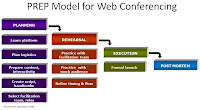 nferences to be successful, instructors need to devote time to planning the event, including optimizing the content and exercises for a virtual classroom, getting the right facilitation team in place, rehearsing for the live delivery and finally, evaluating what happened. These steps are the key steps of the PREP (Planning, Rehearsal, Execution and Post Mortem) Model for Web Conferencing. For more information on this model, view an article in ATD Learning Circuits.
 nferences to be successful, instructors need to devote time to planning the event, including optimizing the content and exercises for a virtual classroom, getting the right facilitation team in place, rehearsing for the live delivery and finally, evaluating what happened. These steps are the key steps of the PREP (Planning, Rehearsal, Execution and Post Mortem) Model for Web Conferencing. For more information on this model, view an article in ATD Learning Circuits.
 The final step of the four-step PREP model for web conferencing that I’ve been writing about for the last few days is the Post Mortem.
 Over the last few days I’ve been writing about a four-step model for web conferencing known as the PREP Model. PREP stands for Planning, Rehearsal, Execution and Post Mortem. Today’s post elaborates on the Execution step.
 Web conferences that require the most amount of time and effort are web conferences for formal events. Whether the purpose of your web conference is to teach college students irregular verbs in Spanish or to teach staff how to have a performance management conversation with their manager, there are core steps that all web conferences have in common.