• Global Virtual Training Resources,  Online Facilitation

    Recipe for success in a web conference

    What does it take to put together a successful web conference where participants and facilitators exchange valuable knowledge, are energized and hungry for more? Whether you are using web conferencing to deliver training, hold a meeting, host a knowledge sharing session or other event, there are three ingredients to consider for a successful event:

    • One part well-designed content
    • One part engaging facilitation
    • One part well-planned event management

    Let’s explore each ingredient…

    Content: The topic and content of your web conference will attract your audience to enroll in your event, so, to state the obvious, your content must be relevant for your audience. If you are converting face-to-face training to delivery via web conference, plan for about 3 hours to convert every 1 hour of material. Converting your content should include trimming your content so there’s less ‘talking to’ and more ‘interacting with’ the audience, adjusting exercises by maximizing the features available in your meeting room and adjusting your PowerPoint slides to include images that illustrate key concepts and slides that cover one key concept only.

    Facilitation: While good content will attract your audience to your online session, great online facilitation will keep them tuned into your session. A good online facilitator knows how to connect with the audience, in spite of being blind to the audience. He or she does this using a variety of techniques such as engaging the audience early and often, using clear and precise language that is free from slang, and giving the audience time to respond to verbal questions, to polls and to type responses in chat. The online facilitator is also adept at scanning their computer screen continuously to “see” what the audience is doing: are they chatting, raising a hand, have they stepped away from your screen or their desk. Needless to say, a good online facilitator is an excellent multi-tasker.

    Event management:  This ingredient is a mix of everything else that goes into web conference.  Event management begins with the initial meeting invitations, continues to the live event management and ends with follow up communications, and all of these pieces should be integrated.  Most web conferences benefit tremendously from having a second person online during the event, whose role is to manage the meeting room and support the lead facilitator.  This role, often referred to as the Producer role, helps to keep all the moving parts of a web conference in sync.  The Producer also helps participants to test their computer before the event, troubleshoots technical problems during the event and manages post event activities such as getting the web conference recording circulated to the right people.

    Mix these three ingredients together, add a twist of great internet connectivity and then toast to your success!
  • Global Virtual Training Resources

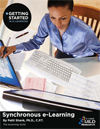
    e-Book Review: Getting Started with Synchronous e-Learning

    The e-Learning Guild recently published an e-Book by Patti Shank entitled: Getting Started with Synchronous e-Learning. This 48-page research report is based on a survey conducted by the eLearning Guild with over 3,000 respondents.

    The report includes an interpretation of the survey data with a range of tables and charts. If you are trying to determine which synchronous e-learning (also referred to as virtual classroom) tool to purchase, there is an analysis of the top vendors, including the top applications by used by organizations based on their size and industry affiliation.

    Intertwined with the data analysis are definitions, tips and best practices for designers and facilitators. If you are trying to learn synchronous e-learning facilitation techniques, Shank provides presentation tips and examples including screen shots of various virtual classroom activities.

    Finally, if you want to dive deeper into the world of synchronous training, the report concludes with a generous list of references and resources.  This report is a quick read and well worth the time to see current research and pick up a few tips on for successful synchronous e-learning.  Access to the report is provided to Guild Members, Member Plus, or Premium Members.

    Disclosure:  I am a member of the e-Learning Guild

  • Global Virtual Training Resources,  Online Facilitation

    Podcast and Job Aid on Web Conferencing

    Recently I was interviewed by Charles Gluck for a podcast by the Metro DC Chapter of ASTD. The podcast covers suggestions and ideas for improving web conferences, the roles of the facilitation team, and how to calculate carbon emissions savings when traditional training is delivered via web conference.

    You can listed to the podcast by going to Metro DC ASTD Podcast.

  • Global Virtual Training Resources

    ELearning Web Sites

    It’s a new year and a great time to set goals. One of mine is to keep my finger on the pulse of what’s going on in the e-learning industry. I’ve compiled a list of useful e-learning websites, many with free newsletters that may be of use.

    Association for Talent Development
    https://www.td.org/
    World’s largest organization dedicated to workplace learning and performance professionals. Learning Circuits is ASTD’s online e-learning source for the latest learning technology news and ideas. Go to ASTD home > Publications > Learning Circuits.

    Brandon Hall Research
    http://brandonhall.com
    Independent research on e-learning trends, best practices, tools and vendors.

    Chief Learning Officer Magazine
    http://www.clomedia.com/
    Articles on a variety of topics and trends in training, and is especially good for organizational issues and innovations in e-learning.

    Distance Educator
    http://www.distance-educator.com/
    Provides publications and research from education, corporate, government/military sectors and is a good site for current news in e-learning. Free weekly newsletter.

    E-Learning Centre
    http://www.e-learningcentre.co.uk/
    Comprehensive portal of information on e-learning, covering key issues and links to key publications and reports.

    E-Learning Guild
    http://www.elearningguild.com/
    The Guild provides a good source of surveys and reports on trends in e-learning. Different levels of membership provide access to different information, however the free membership level includes a subscription to Learning Solutions eMagazine and eLearning Insider.

    Learning for International NGOs (LINGOS)
    http://ngolearning.org/
    Mission is to facilitate the creation, development and support of learning environments in the humanitarian relief, development and environmental sector. Members gain access online courses and e-learning tools.

    MASIE Center Learning Lab and Think Tank
    http://www.masie.com/
    Source of information on technology, business, learning and workplace productivity run by Elliot Masie. Free e-newsletter subscription called Learning TRENDS.

    Society for Applied Learning (SALT)
    http://www.salt.org/
    SALT is a professional society that offers resources and conferences for those in the field of instructional technology. Sponsors three journals: Journal of Instruction Delivery Systems, Journal of Interactive Instruction Development and Journal of Education Technology Systems.

    Sloan-C
    http://www.sloan-c.org/
    A Consortium of Institutions and Organizations Committed to Quality Online Education. Publishes the Journal of Asynchronous Learning Networks and the Sloan-C View, a free weekly newsletter.